"一口气,从雅典横渡到北京/让每一个人都拥有世界级的竞技舞台。/中国网通,以先进的宽带技术,构建通达世界的通信网络,全力支持北京2008年奥运会。/中国网 宽天下"
(中国网通形象广告)

"In one breath, from Athens to Beijing/Let everyone have a global competition stage./China Unicom, thanks to an advanced broadband technology, creates a world communication network, and fully supports Beijing 2008 Olympics./China network broadens the Tianxia"
(China Unicom corporate advertisement)

"In un respiro, da Atene a Pechino/In modo che tutti possano stare su un palcoscenico mondiale./China Unicom, grazie ad un'avanzata tecnologia broadband, crea una rete di comunicazione globale e supporta le Olimpiadi di Pechino 2008./China Unicom amplia il Tianxia"
(pubblicità corporate di China Unicom)

2011-03-21

"RAIDING AFRICA": African filmakers exploring China

The 21th edition of the African, Asian and Latin American Film Festival (http://www.festivalcinemaafricano.org/eng/index.php), held in Milan, begins today (March 21) and lasts until March 27. After the success of "Forget Africa" (a program that took place and involved international filmmakers encountering for their first time Africa), this year the collaboration with the International Film Festival Rotterdam (IFFR, http://www.filmfestivalrotterdam.com) continues: this time, though, the perspective has completely been turned upside down, thanks to the special section "Raiding Africa" (http://www.festivalcinemaafricano.org/eng/index.php?pag=sez_retrospettiva). 
"Raiding Africa" is the name of a program involging seven African filmmakers (coming from Sudafrica, Uganda, Ruanda, Congo-Brazzaville and Angola) and that shows their first encounter with China. I believe it is a wonderful opportunity to see China in a very different and new way, that's why I strongly recommend it! You can get a glimpse of this China - seen through African's creative eyes - online, in the festival blog from Gertjan Zuilhof, who travelled in China with the group of young directors (in total, 13 posts are currently available and many nice pictures of the journey). A synopsis of each of the seven films is available here (in Italian).


(Henrique "Dito" Narciso filming for Moamba Chinesa)

(Still image from Li Xia's Salon, by Omelga Mthiyane)


La 21ma edizione del Festival Cinema Africano, Asia e America Latina (http://www.festivalcinemaafricano.org/), che si tiene a Milano, inizia oggi (21 marzo) e proseguirà fino al 27 marzo. Dopo il successo di "Forget Africa" (un progetto che ha coinvolto vari registi internazionali nel momento del loro primo incontro con l'Africa), quest'anno la collaborazione con l'International Film Festival di Rotterdam (IFFR, http://www.filmfestivalrotterdam.com) continua: questa volta, però, la prospettiva è stata completamente stravolta, grazie alla speciale rassegna "Raiding Africa" (http://www.festivalcinemaafricano.org/index.php?pag=sez_retrospettiva). 
"Raiding Africa" è il nome di un progetto che riguarda sette registi africani (provenienti da Sudafrica, Uganda, Ruanda, Congo-Brazzaville e Angola) e mostra il loro primo incontro con la Cina. Credo che si tratti di una bellissima occasione per vedere la Cina in una maniera diversa e nuova, ed è per questo che ve lo raccomando! Si può avere un'idea di questa Cina, vista attraverso occhi africani, online, nel blog del festival di Gertjan Zuilhof, che ha viaggiato in Cina con il gruppo di giovani registi (in totale ci sono 13 post e molte foto del viaggio). La trama di ognuno dei sette film è disponibile qui (in italiano).


2011-03-20

CHINA POWER STATION II

I really like Cao Fei's artistic style: after my last post entitled CHINA POWER STATION I, I kept looking for her works, as something else displayed in the exhibition in Turin drew my attention: a few big pictures hanging on the wall and a video. The pictures were still imaeges taken from a documentary she did in 2004, entitled "Cosplayers" (an ultra-brief - and probably unnecessary - explaination: the word "cosplay" is the contraction of "costume" and "play", it originated in Japan and refers to a sort of performance art, in which participants dress up like some famous fictional characters, usually drawn from manga, anime, comics, animation, video games, and so on). Unfortunately, I couldn't find Cao Fei's video online, but on her website I found a statement from which I would like to propose an exerpt, as it describes a peculiar phenomenon of popular culture that is becoming extremely trendy also in China: 

"In recent years a group of COSPLAYERS, growing up in and around China's coastal cities, have been confronted by both the traditional values of the Chinese education system and subjected to the pull of invading foreign cultures in the new century. As a group of adolescents who refuse to grow-up, they choke themselves with passionate impulses and an undisguised infatuation with personal fancies, expressed through ways and manners only they can understand and be comfortable with. Their characters are often filled with violence, a thirst for power, as well as magical powers but, compared to the boredom, emptiness, rebelliousness, and violence that accompany the lives of many of today's adolescents, escaping inside this sub-cultural cocoon merely seeks to affirm the value of their own existence in society. They frequently and eagerly appear in all kinds of large and small commercial events or trendy places, gaining exposure in the news media, and setting themselves up as spoke-persons for young people today. In the process they attract the attention of many curious onlookers and a sizable peer group following. The satisfaction they gain from their contrived fantasy world counterbalances their despair and despondency in the real world. In fact, since they seek to hide their personality, the pleasure and sense of honor they gain derives from their virtual characters, not their natural identity. They are prepared to shoulder the burden of a split personality in the everyday world, for such a duality of reality and fantasy soothes and comforts their cravings in the same way as fairy tales have become an indispensable part of their lives." (http://www.caofei.com/works/photography/, choose "Coldplayers" on the right and this statement can be found after the first still)

Other photographic works about cosplayers are displayed on her website: Un-Cosplayers and Cos-Cosplayers. From this last series, I chose the ones I like best and share them here. I guess I like them because I appreciate the contrast of the romantic gothic outfit and the "bad" elements (namely the helmets) of Darth Vader and Stormtroopers from George Lucas' Star Wars.


Mi piace lo stile artistico di Cao Fei: dopo aver postato CHINA POWER STATION I, ho continuato a cercare le sue opere, visto che qualcos'altro esposto alla mostra di Torino mi aveva incuriosito: alcune fotografie appese al muro e un video. Le fotografie erano immagini still prese da un documentario del 2004, intitolato "Cosplayers" (una velocissima - e probabilmente non necessaria - spiegazione: la parola "cosplay" è la contrazione di "costume" e "play", ha avuto origine in Giappone e indica una sorta di arte performativa, in cui i partecipanti si vestono come alcuni personaggio famosi, di solito provenienti da manga, anime, fumetti, animazioni, video giochi, e così via). Purtroppo, non ho trovato il video di Cao Fei, ma nel suo sito ho trovato una dichiarazione, di cui voglio proporre un estratto, visto che descrive un fenomeno peculiare delle cultura popolare, che sta diventando di tendenza anche in Cina: 

"In recent years a group of COSPLAYERS, growing up in and around China's coastal cities, have been confronted by both the traditional values of the Chinese education system and subjected to the pull of invading foreign cultures in the new century. As a group of adolescents who refuse to grow-up, they choke themselves with passionate impulses and an undisguised infatuation with personal fancies, expressed through ways and manners only they can understand and be comfortable with. Their characters are often filled with violence, a thirst for power, as well as magical powers but, compared to the boredom, emptiness, rebelliousness, and violence that accompany the lives of many of today's adolescents, escaping inside this sub-cultural cocoon merely seeks to affirm the value of their own existence in society. They frequently and eagerly appear in all kinds of large and small commercial events or trendy places, gaining exposure in the news media, and setting themselves up as spoke-persons for young people today. In the process they attract the attention of many curious onlookers and a sizable peer group following. The satisfaction they gain from their contrived fantasy world counterbalances their despair and despondency in the real world. In fact, since they seek to hide their personality, the pleasure and sense of honor they gain derives from their virtual characters, not their natural identity. They are prepared to shoulder the burden of a split personality in the everyday world, for such a duality of reality and fantasy soothes and comforts their cravings in the same way as fairy tales have become an indispensable part of their lives." (http://www.caofei.com/works/photography/, scegliere "Coldplayers" alla destra e questa dichiarazione comparirà sotto alla prima immagine still).

Nel suo sito, si possono trovare altre opere fotografiche sui cosplayers: Un-Cosplayers e Cos-Cosplayers. Di quest'ultima serie, ho scelto le foto che mi hanno colpito e le ripropongo qui. Credo mi piacciano perché apprezzo il contrasto dell'abbigliamento romantico/gotico e gli elementi "cattivi" (gli elmi) di Darth Vader e degli Stormtroopers della serie Guerre Stellari di George Lucas.


2011-03-11

CHINA POWER STATION I

To my surprise, the exhibition on Chinese contemporary art I missed last time I was in Turin has been delayed until the end of March! I really didn't want to loose this chance and I went to visit, just before getting on the train to go back home. The name of the exhibition is CHINA POWER STATION and it is currently hosted by Pinacoteca Agnelli (Lingotto). I was lucky to find a very nice guide and a group of people who wanted to visit with the help of some detailed explainations, so I spent there a few hours. Among the works I saw, I was fascinated by "i·MIRROR" (我·镜), a second life documentary film. This video, that was also featured in the Chinese Pavillon during the Venice Biennale in 2007, was shot by China Tracy, the second life avatar of the Chinese artist Cao Fei 曹斐. I have to be honest: as I was afraid of missing my train, I didn't have the time to sit down and watch the entire documentary, but I regret that. I found this three parts on Youtube and want to share them with you. The thing that struck me most is that, at least from an outsider's point of view (as I'm not really into contemporary art!) it completely lack Chinese elements.
Here is a link also with some infos on the artist  (http://nwn.blogs.com/nwn/2007/07/this-is-truly-c.html) and the link to her blog  (http://www.caofei.com). Enjoy!

PART 1

PART 2

PART 3

Con mia grande sorpresa, la mostra d'arte cinese contemporanea che avevo perso durante la mia ultima gita a Torino è stata posticipata fino a fine marzo! Non volevo perdere quest'occasione e sono andata a visitarla, proprio prima di prendere il treno per tornare a casa. Il nome della mostra è CHINA POWER STATION e al momento è ospitata dalla Pinacoteca Agnelli (Lingotto). Sono stata fortunata a incontrare una guida simpatica e un gruppo di persone che volevano fare una visita con l'aiuto di alcune spiegazioni dettagliate, quindi sono stata lì un paio d'ore. Tra le opere che ho visto, sono rimasta affascinata da "i·MIRROR" (我·镜), un film/documentario sulla seconda vita. Questo video, esposto anche nel Padiglione cinese alla Biennale di Venezia nel 2007, è firmato China Tracy, l'avatar dell'artista Cao Fei 曹斐. Sarò sincera: avendo paura di perdere il treno, non ho avuto il tempo per sedermi e vedere tutto il documentario, ma me ne pento. Ho trovato le tre parti su Youtube e le condivido qui. La cosa che mi ha colpito di più è che, almeno dal punto di vista di una outsider (visto che non sono proprio per l'arte contemporanea!) manca completamente di elementi cinesi. 
Qui un link con alcune informazioni anche sull'artista (http://nwn.blogs.com/nwn/2007/07/this-is-truly-c.html) e qui il link al suo blog (http://www.caofei.com). A voi!

China@Turin

I've recently been invited to a seminar entitled "La via cinese ai media" (the Chinese way to media), held in Turin, in collaboration with Ordine Giornalisti Piemonte, Scienze della Comunicazione (Università di Torino) and CIRCE (Centro Interdipartimentale di Ricerca sulla Comunicazione). Here is the brochure of the event, that proved to be an interesting occasion for gathering and discussing Chinese media, including television, information system, the Internet and - of course - advertising, also with professionals from the communication sector. I think the picture that has been chosen for the brochure could be used also in one of my courses as a fitting example of the "recycling" of the revolutionary culture in contemporary China (and this is why I like it!). 
This is the link to the PODCAST of my intervention "Advertising 'with Chinese characteristics'":
http://elearning.unito.it/lettere/blocks/inwicast/index.php?id=21


Di recente sono stata invitata ad un seminario intitolato "La via cinese ai media", tenutosi a Torino, in collaborazione con l'Ordine Giornalisti Piemonte, Scienze della Comunicazione (Università di Torino) e CIRCE (Centro Interdipartimentale di Ricerca sulla Comunicazione). Questa è la locandina dell'evento, che si è rivelato essere un'occasione interessante per riunirsi e discutere di media cinesi, televisione, sistema informativo, internet e pubblicità compresa, anche con professionisti della comunicazione. La foto che è stata scelta per la locandina potrebbe essere usata in uno dei miei corsi come esempio calzante di "riciclaggio" della cultura rivoluzionaria nella Cina contemporanea (e, proprio per questo, mi piace!). 
Questo è il link al PODCAST del mio intervento "La pubblicità 'con carattertistiche cinesi'": 

2011-02-09

Better late than never! - Meglio tardi che mai!

Due to the academic calendar, it was really impossible to post regularly...but I'm back now! As I like to keep track of the activities involving me and my students, I post the link to the brochure and some pics of the conference "City Portraits: Beijing" held at IUAV University, last December. 

Per via del calendario accademico, è stato veramente impossibile postare in maniera regolare...ma sono tornata! Dato che mi piace tenere traccia delle attività che coinvolgono me e i miei studenti, posto qui il link alla brochure e alcune foto della conferenza "City Portraits: Beijing", tenutasi lo scorso dicembre allo IUAV.


2010-10-17

CONFERENCE ANNOUNCEMENT: PROF. TAO DONGFENG IS COMING TO CA' FOSCARI! (2)

Next Thursday (October 21), Professor 陶东风 Tao Dongfeng from 首都师范大学 (Capital Normal University) is coming to Ca' Foscari to give a talk entitled "后革命时期中国小说中四种书写革命的模式" (Four models of the Writing about Revolution in the Fictions in Post-Revolutionary China). The event is supported by the Department of East Asian Studies and the C.E.G. (Centro Interdipartimentale su Cultura e Economia della Globalizzazione) from Ca' Foscari University of Venice. Don't miss it!


ANNUNCIO CONFERENZA: IL PROF: TAO DONGFENG VIENE A CA' FOSCARI!  

Giovedì prossimo (il 21 ottobre), il professor 陶东风 Tao Dongfeng della 首都师范大学 (Capital Normal University) verrà a Ca' Foscari per tenere una lezione intitolata "后革命时期中国小说中四种书写革命的模式" (Il racconto della rivoluzione nella Cina post-rivoluzionaria: quattro modelli narrativi). L'evento è promosso dal Dipartimento di Studi sull'Asia Orientale e dal C.E.G. (Centro Interdipartimentale su Cultura e Economia della Globalizzazione) di Ca' Foscari. Da non perdere!

2010-10-14

CONFERENCE ANNOUNCEMENT: PROF. TAO DONGFENG IS COMING TO CA' FOSCARI! (1)

Next Wednesday (October 20), Professor 陶东风 Tao Dongfeng from 首都师范大学 (Capital Normal University) is coming to Ca' Foscari to give a talk entitled "后革命时期革命文化的'复兴'与祛魅" (The "Revival" and Disenchantment of Revolutionary Culture in Post-Revolutionary China). The event is supported by the Department of East Asian Studies and the Confucius Institute at Ca' Foscari University of Venice. Don't miss it!


ANNUNCIO CONFERENZA: IL PROF: TAO DONGFENG VIENE A CA' FOSCARI! 

Mercoledì prossimo (il 20 ottobre), il professor 陶东风 Tao Dongfeng della 首都师范大学 (Capital Normal University) verrà a Ca' Foscari per tenere una lezione intitolata "后革命时期革命文化的'复兴'与祛魅" ("Revival" e disincanto: la cultura rivoluzionaria nella Cina post-rivoluzionaria). L'evento è promosso dal Dipartimento di Studi sull'Asia Orientale e dall'Istituto Confucio presso Ca' Foscari. Da non perdere!

2010-10-08

EXPRESSING THE CHINESE SELF (2): PAYING RESTAURANT BILLS IS GOOD!

Another interesting ad of the 悦己 campaign is this one: a smiling Chinese woman (this time, not chubby at all!) looks right towards the camera and says: "男人付帐值得炫耀, 但自己买单那叫骄傲". The slogan in English would sound like: "When a man pays restaurant bills it is worth showing off, but when I pay bills myself this means being proud". It is worth highlighting that the Chinese slogan sounds more rhytmic than the English version I propose here, as the expressions 耀 and 傲 are homophones (the two characters both read "yào"). This woman looks more sophisticated if compared to the chubby woman of the previous ad I analyzed: we can see she is holding a leather bag, wearing an elegant necklace and a silk-like black blouse, and her hairstyle is fancy: all these visible signs lead us to think that she is a woman who cares about herself and treats her well. But the most important thing, strictly connected to the slogan, is that she treats herself well also from an economic point of view: as a matter of fact, in both hands (sorry, this picture is not complete!), she is holding a variety of credit cards, a clear sign of "wealth". Thus, the one depicted here is a new Chinese woman: a worker, who is proud of being able to pay herself restaurant bills, if she wants to. In the meantime, she is a woman who likes also to be asked out for dinner and possibly is very successful with men (it is very interesting that the slogan uses the generic and undefined term 男人, "man/men", instead of a more traditional 我男朋友, "my boyfriend", or a stronger 我男人, "my man"; or, again, a more serious 我丈夫, "my husband", or a more colloquial 我老公, "my husband"). Therefore, the new Chinese woman depicted here is still very feminine (and likes to show it), but surely more economically independent. I just wonder whether she would actually invite and pay a man's dinner - and this would make her really sexually and economically empowered - or just pay her own restaurant bills. Or if she gets her dinners paid by men and show it off (demonstrating that she is attractive) and use her money to go to the hairdresser's and shopping. Any idea?


Un altro annuncio interessante della campagna 悦己 è il seguente: una sorridente donna cinese (questa volta per niente tondetta!) guarda dritto verso l'obiettivo e dice: "男人付帐值得炫耀, 但自己买单那叫骄傲". Lo slogan, tradotto in italiano, suona così: "Quando un uomo invita a cena è da mostrare, ma l'orgoglio c'è se sono io a pagare". E' importante sottolineare che lo slogan in cinese suona rimato, dato che i termini 耀 e 傲 sono omofoni (la lettura di entrambi i caratteri è "yào"), rima che ho cercato di mantenere nella traduzione in italiano che propongo qui. Questa donna appare più sofisticata se paragonata alla donna paffuta dell'annuncio che ho analizzato prima: possiamo vedere che ha una borsa di pelle, indossa un'elegante collana e una camicia che sembra di seta e la sua acconciatura è ricercata: questi segni visibili ci portano a pensare che sia una donna attenta a se stessa e che si tratta bene. Tuttavia, la cosa più importante, e strettamente connessa allo slogan, è che si tratta bene anche da un punto di vista economico: infatti, in entrambe le mani (purtroppo la foto non è completa!) tiene varie carte di credito, segno inconfondibile di "ricchezza". Quindi, anche quella rappresentata qui è una nuova donna cinese: una lavoratrice, che è fiera di pagarsi il ristorante da sola, se lo vuole. Al contempo, è una donna che apprezza essere invitata a cena e probabilmente che ha successo con gli uomini (infatti, è molto interessante che lo slogan impieghi un termine come 男人, "uomo/uomini", al posto di un tradizionale 我男朋友, "il mio ragazzo", o un forte 我男人, "il mio uomo"; o, ancora, un serio 我丈夫, "mio marito", o il colloquiale 我老公, "il mio maritino"). Quindi, la nuova donna cinese rappresentata qui è ancora molto femminile (e le piace mostrarlo), ma sicuramente è economicamente più indipendente. Mi chiedo solamente se inviterebbe a cena un uomo pagando anche per lui - e questo la renderebbe sessualmente ed economicamente potente - oppure se si paga semplicemente le sue cene. Oppure se si fa pagare le cene dagli uomini (dimostrando così che è attraente) e usa i soldi per pagarsi il parrucchiere e fare shopping. Qualche suggerimento?

2010-09-24

TONIGHT IS THE (VE)NIGHT!

Time for another announcement: today, 24th September, is the European Researchers' Night. The event has been taking place in different countries of the European Union starting from 2005, every fourth Friday of September. This year, 250 cities of 33 European countries are giving an opportunity for everybody to get "Face to face with European researchers". Venice is one of them: Ca' Foscari University and IUAV University are taking part to the event, with a variety of activities, such as Corner Europei and Spritz con la Scienza. If you happen to be near Campo Santa Margherita, at around 18:00, you can join my Spritz con la Scienza, entitled: "Beijing Welcomes You: Words, Images and Sounds from Beijing 2008 Olympics". We will have a glimpse of the Beijing 2008 Olympics, through the screening of the opening ceremony and the famous theme song for 100-day Olympic countdown: "北京欢迎你" (Beijing Welcomes You). At 20:00 the Auditorium in Campo Santa Margherita will host a concert from Artemoltobuffa and Mercanti di Liquore...so be there! And give research a chance...


TONIGHT E' LA (VE)NIGHT!

E' il momento di un altro annuncio: oggi, 24 settembre, è la Notte Europea dei Ricercatori. Questo evento è iniziato in vari paesi dell'Unione Europea a partire dal 2005, ogni quarta settimana del mese di settembre. Quest'anno, 250 città di 33 paesi dell'Unione Europea stanno dando l'opportunità di incontrarsi "Faccia a faccia con i ricercatori europei". Venezia è una di queste città: l'Università Ca' Foscari e IUAV prendono parte all'evento, con una varie modalità come i Corner Europei e gli Spritz con la Scienza. Se capiti vicino al Campo Santa Margherita, verso 18:00, potresti unirti al mio Spritz con la Scienza, intitolato: "Pechino ti dà il benvenuto: parole, immagini e suoni dalle Olimpiadi di Pechino 2008". Ci faremo un'idea delle Olimpiadi di Pechino 2008, grazie alla visione della cerimonia di apertura e della canzone trasmessa 100 giorni prima dell'inizio dei Giochi: "北京欢迎你" (Pechino ti da' il benvenuto). Alle 20:00 l'Auditorium di Campo Santa Margherita ospiterà un concerto di Artemoltobuffa e Mercanti di Liquore...non mancare! E dai un'opportunità alla ricerca...

2010-09-14

CONFERENCE ANNOUNCEMENT: PROF. LIU LINQING IS COMING TO CA' FOSCARI! BE THERE!

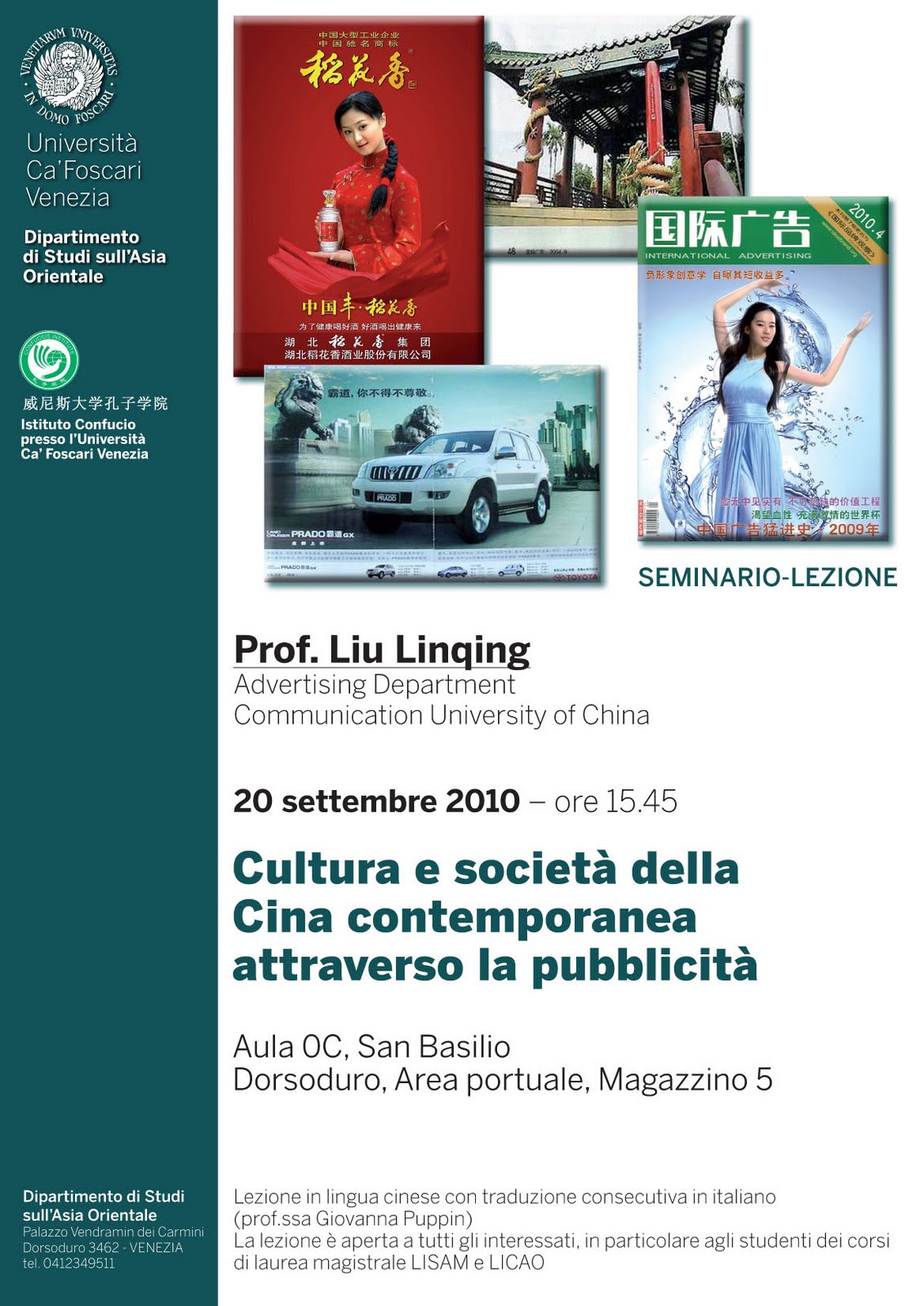
Sorry if I interrupt the posting on 悦己, but as this is a blog on Chinese advertising I think it's my duty to advertise an important event that will take place next Monday (September 20), in concomitance with the start of the 2010/2011 Academic Year at Ca' Foscari University of Venice and with the beginning of my new course "Chinese Identity through Logos, Brands and Marketing". Professor 刘林清 Liu Linqing from the Advertising Department of 中国传媒大学 is coming to Ca' Foscari to give a talk entitled "从商业广告透视当前中国社会文化" (Chinese contemporary culture and society through advertising). The event is supported by the Department of East Asian Studies and the Confucius Institute at Ca' Foscari University of Venice. I will be in charge of the translation into Italian and I hope there will be a vast audience, as this is the first time a Chinese professor comes to Italy to give a talk on Chinese contemporary advertising! So don't miss it! 


ANNUNCIO CONFERENZA: IL PROF: LIU LINQING VIENE A CA' FOSCARI! NON MANCATE! 

Scusate se mi intrufolo tra i post su 悦己, ma dato che questo è un blog sulla pubblicità cinese, credo sia giusto pubblicizzare un evento importante che avrà luogo lunedì prossimo (il 20 settembre), in concomitanza con l'inizio dell'Anno Accademico 2010/2011 dell'Università Ca' Foscari di Venezia e con il mio corso "L'identità cinese attraverso marchi, marche e marketing". Il professor 刘林清 Liu Linqing del Dipartimento di Pubblicità della 中国传媒大学 verrà a Venezia per tenere una lezione intitolata "从商业广告透视当前中国社会文化" (Cultura e società della Cina contemporanea attraverso la pubblicità). L'evento è promosso dal Dipartimento di Studi sull'Asia Orientale e dall'Istituto Confucio presso Ca' Foscari. Sarò responsabile della traduzione in italiano e spero che ci sarà un vasto audience, dato che è la prima volta che un professore cinese viene in Italia per parlare della pubblicità cinese! Non mancate!

2010-09-13

EXPRESSING THE CHINESE SELF (1): FAT IS GOOD!

So far, this is one of the ads of the 悦己 campaign that I like most. It consists of a black and white picture of a chubby Chinese woman, who is laughing in such a contagious way that you can't help smiling. The slogan is written in orange characters and says: "一点点赘肉别紧张,杨贵妃照样迷死唐明皇". A possible English translation could be: "Some superfluous meat should not make you worry, since this is how Yang Guifei seduced to death Tang Ming Huang". Yang Guifei is a very famous female figure in Chinese culture, as she became Tang Ming Huang/Emperor Xuanzong's consort (after being also his son's consort) during the prosperous Tang Dynasty. Actually, she died in a very sad way, but her beauty and  death are said to have caused the descend of the Tang Dynasty (and this is why the slogan ironically uses the expression 迷死, literally 迷 means "to enchant, to fascinate", and 死 means "to death", as she actually was the one who died).  She is considered one of China's Four Great Beauties, together with 西施 Xi Shi, 王昭君 Wang Zhaojun, and 貂蝉 Diao Chan. She was commonly known for being quite chubby, characteristic that was considered a good quality during that time (and distinguished her from skinny beaty canons, such as the on embodied by 赵飞燕 Zhao Feiyan, who conquered Emperor Cheng of the Western Han Dynasty thanks to her slimness, as explained by the chengyu “环肥燕瘦” - "plump Huan, slender Yan", where 环 Huan stands for 杨玉环, alias Yang Guifei). And this is exactly the kind of beauty that the testimonial of 悦己 is advocating: a fleshy beauty that still can be attractive (after all, the important thing is to be yourself)! Following the slogan, we find the link to the Chinese SELF website (http://www.self.com.cn), and a picture of the front cover of the magazine (that appears inside a comic-style balloon, and therefore seems "spelled out" by the testimonial). From the small front cover, we can see the name of the magazine (悦己 SELF), its price (15 yuan), the main topic (快乐由自己, that appears also in the logo of the magazine), and that it just came to the market (全心上市). It is worth highlighting that, when a product firstly appears on the Chinese market, the common way of referring to it is: 全新上市 (literally: "complete" + "new" + "go up, get on" + "market"), while here the second character (心) is still read xin1 (thus is an homophone of  新, "new"), but means "heart", "mind", "soul". In perfect harmony with the requirements the magazine had to meet in order to sell to the Chinese consumers (see previous post).


L'ESPRESSIONE DEL SELF CINESE (1): GRASSO E' BELLO!

Alla lunga, questo è uno degli annunci pubblicitari della campagna 悦己 che mi piace di più. E' costituito da una foto in bianco e nero che ritrae una donna cinese paffutella che ride in modo contagioso, tanto che non ci si può astenere dal sorridere. Lo slogan è scritto in caratteri di color arancione e dice: "一点点赘肉别紧张,杨贵妃照样迷死唐明皇". Una possibile traduzione in italiano: "Un po' di carne superflua non ti deve preoccupare, perché fu così che Yang Guifei sedusse fatalmente Tang Ming Huang". Yang Guifei è una figura femminile molto famosa nella cultura cinese, poiché è diventata la consorte di Tang Ming Huang/Imperatore Xuanzong (dopo aver sposato anche il figlio) durante la ricca Dinastia Tang. In realtà, è molta in maniera tragica, ma la sua bellezza e la sua morte vengono ritenute responsabili della caduta della Dinastia Tang (ed ecco perché lo slogan utilizza in maniera ironica l'espressione 迷死, letteralmente 迷 significa "incantare, affascinare" e 死 significa "fino alla morte, da morire", dato che è stata lei a morire per prima).  Viene considerata una delle Quattro grandi bellezze cinesi, assieme a 西施 Xi Shi, 王昭君 Wang Zhaojun e 貂蝉 Diao Chan. Era conosciuta per essere abbastanza tondetta, caratteristica che veniva considerata un pregio a quell'epoca (e l'ha contrapposta a canoni di bellezza decisamente filiformi, come quello rappresentato da 赵飞燕 Zhao Feiyan, che con la sua magrezza conquistò l'Imperatore Cheng della Dinastia degli Han Occidentali, come spiegato nel chengyu “环肥燕瘦” - "Huan grassa, Yan magra", dove 环 Huan sta per 杨玉环, alias Yang Guifei). E questo è proprio il modello di bellezza che la testimonial di 悦己 vuole sponsorizzare: una bellezza carnosa può comunque essere attraente (alla fine, l'importante è essere se stessi!) Dopo lo slogan, troviamo il link al sito di SELF cinese (http://www.self.com.cn) e una foto della copertina della rivista (che compare dentro a una nuvoletta stile fumetto e sembra "pronunciata" dalla testimonial). Dalla piccola foto della copertina, riusciamo a distinguere il nome della rivista (悦己 SELF), il prezzo (15 yuan), il tema centrale (快乐由自己, che compare anche sotto il logo della rivista), è che appena entrato sul mercato (全心上市). Vale la pena evidenziare che, quando un prodotto entra per la prima volta sul mercato cinese, l'espressione che viene comunemente usata è: 全新上市 (letteralmente: "completo" + "nuovo" + "entrare" + "mercato"), mentre qui il secondo carattere (心) viene comunque letto xin1 (quindi è omofono di 新, "nuovo"), ma significa "cuore", "mente", "anima". In perfetta armonia con le caratteristiche che la rivista doveva soddisfare per riuscire a vendere ai consumatori cinesi (vedi post precedente).